
New Makerspace for SCIENCE
With a DKK 42.3 million grant from the Novo Nordisk Foundation, SCIENCE is establishing a new Makerspace designed to boost innovation and create entirely new frameworks for practice‑based teaching.
Imagine you are a lecturer planning a course on machine learning. Now imagine that your students are not working with ready‑made datasets, but with data they have created themselves through instruments or models they have built or 3D‑printed. Or that you can have new demonstration devices developed for use in an auditorium to illustrate the effects of Einstein’s theory of relativity.
Such ideas have long been possible in theory but difficult to realise in practice. They require access to machines, materials, workshop facilities and technical expertise—resources that most lecturers at SCIENCE do not have today. With the new SCIENCE Makerspace, learning‑through‑making is becoming a real possibility.
From vision to reality
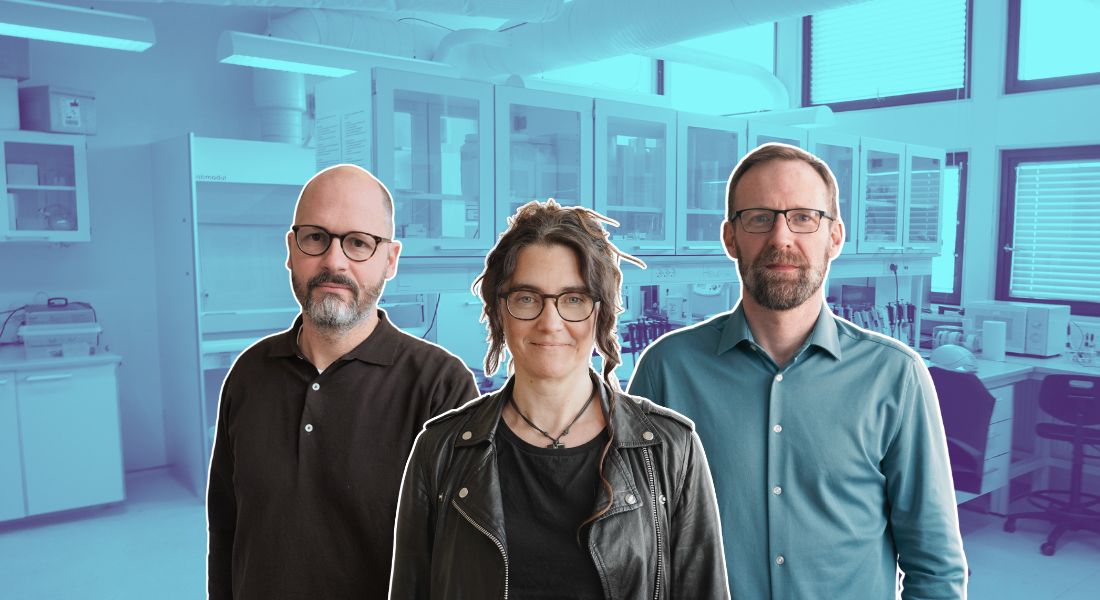
Behind the project stand three key driving forces: Professor Pernille Bjørn from the Department of Computer Science (DIKU), Associate Professor Jason Koskinen from the Niels Bohr Institute (NBI) and Professor Morten Misfeldt from the Department of Science Education (IND) and DIKU. They all welcome the opportunities a SCIENCE Makerspace will create – for both students and lecturers.
“It will be an educational and creative sandbox where students and educators can bring their ideas, creativity and enthusiasm, and receive the support they need to realise them. With expert staff, equipment, tools and raw materials on site, SCIENCE Makerspace aims to remove the barriers that would otherwise limit new ideas about how lecturers teach and how students learn,” says Jason Koskinen.
For Pernille Bjørn, there is no doubt that the establishment of the SCIENCE Makerspace is a long‑held wish now coming true.
“Since I joined UCPH in 2015, I’ve worked to create a makerspace as a teaching environment that makes room for learning‑through‑doing,” she says.
“I want to create a space that makes it possible to experience computer science in new ways. That’s why, back in 2017, we borrowed 3D printers from outside the University of Copenhagen for a so‑called Makerweek that we organised ourselves to demonstrate the potential of this form of teaching and learning.”
The lack of machines and facilities meant that up until now, these ideas could only be tested in temporary setups. Even so, the early experiments showed that the potential stretched far beyond a few courses with particularly dedicated lecturers. This is why there was great excitement when DIKU, NBI and IND, together with the SCIENCE Faculty, began negotiations and collaboration with the Novo Nordisk Foundation.
What is a makerspace?
The Makerspace will be an open, shared development environment with access to equipment such as 3D printers, laser cutters, a CNC machine, programmable embroidery machine, 3D clay printers, e-textiles and electronics.
It is designed as a place where users can:
- prototype new ideas
- experiment with concepts and materials
- explore digital technologies in new ways
- work experimentally and inquisitively
- develop cross‑disciplinary knowledge
The aim is to create a space where idea generation, craftsmanship and technological exploration meet – and where both new and experienced students and lecturers can learn together.
An open workshop for the entire faculty
For the three main forces behind the application, it is crucial that the makerspace becomes an open and experimental development environment – a place where students, lecturers and researchers can meet to explore ideas together.
“I’m excited to see how students and researchers start using the makerspace in ways we simply cannot foresee,” says Morten Misfeldt. “When you have a space where ideas can be built, tested and adjusted, it creates entirely new opportunities for experimental and cross‑disciplinary work.”
He sees particular potential in how the space can reshape both collaboration and learning processes:
“We know that something unique happens when people work with materials and prototypes – when complex concepts take physical form. It gives us a chance to explore how students learn when they build and develop things together.”
This unfolding potential also excites SCIENCE’s Associate Dean for Education, Andreas de Neergaard:
“It is fantastic that SCIENCE is now getting a Makerspace where students can build, experiment and innovate. We hope this is the first step towards new forms of engagement, immersion and learning environments.”
SCIENCE Makerspace will accommodate both course activities and student‑driven projects – from bachelor projects and master’s theses to tech workshops and open development programmes. An Expert‑in‑Residence programme will give researchers and students the opportunity to collaborate with external professionals such as artists and craftspeople on specialised educational activities.
Next steps
In the coming months, work will begin to define the layout, equipment and organisational setup. The first courses will be anchored at NBI and DIKU, but the goal is to quickly open the space to the entire faculty – and to students from across UCPH who bring their own projects.
“Now the real work begins,” says Pernille Bjørn. “We not only need to establish the physical space but also build a community across students and staff. A makerspace is not just about machines but about the people and activities shaping the space.”
The plan is for SCIENCE Makerspace to open its doors in late 2026, and for it to gradually fill with projects and experiments – and the traces they leave behind. Or, as Jason Koskinen puts it:
“I look forward to the diversity of successful and less successful projects that will gradually adorn the walls, shelves and perhaps even ceilings. A physical history of creativity and curiosity made up of wires, fabric, plastic, tape, circuit boards, paint and metal.”
SCIENCE Makerspace will be located on North Campus in the H.C. Ørsted Building in Universitetsparken.
After five years, the faculty expects that more than 3,300 students from various study programmes will have participated in at least one activity in the Makerspace.
Contact
Andreas de Neergaard
Associate Dean for Education at SCIENCE
E-mail: proudd@science.ku.dk
Mobile: +45 24 43 43 31
Johanne Klindt Gahrn
Communications Consultant
E-mail: jkg@adm.ku.dk
Mobile: +45 35 33 63 66