
Grant
9 December 2025
Prestigious ERC Consolidator Grant to Associate Professor Joanna Bergström
Virtual Reality
Her new project aims to build the first scientific foundation for how humans learn to control virtual bodies – unlocking safer, more effective, and more immersive VR experiences with wide societal impact.
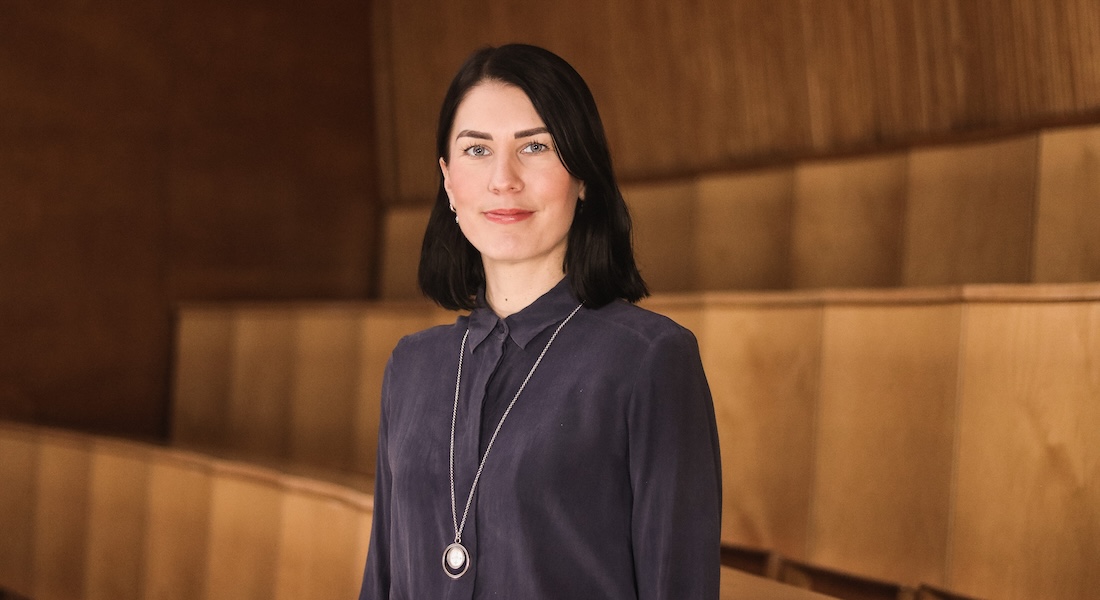
- I am incredibly honoured and grateful. The ERC Consolidator Grant is one of the most competitive research grants in Europe, and receiving it is both humbling and motivating. It gives me the opportunity to take a bold step forward and explore ideas that could reshape Virtual Reality at large, says Joanna Bergström.
VR interactions that match the brain
Virtual reality allows people to move, act, and inhabit bodies beyond what is possible in the physical world. But to make this feel natural, VR systems rely on mapping techniques – the rules that translate our physical movements into virtual ones.
These techniques make it possible to walk farther in VR than your room allows, to reach farther than your arm permits, or even to move in ways you cannot in real life. Yet despite their importance, there is still no scientific foundation for how these mappings should be designed.
With her new ERC-funded research project, MOVR, Associate Professor Joanna Bergström will establish that missing foundation using insights from motor learning – the neuroscience of how humans acquire new movements, like learning to ride a bike. She explains:
- In VR, people also need to learn how to use their virtual body. By applying insights from motor learning, we can design VR interactions that align with how the brain actually works.
Wide range of applications
More effective mapping techniques could unlock far more convincing and usable VR. Today, poorly designed interactions can cause discomfort, sickness, and frustration, and limit how well skills learned in VR transfer to the real world. MOVR aims to change that fundamentally.
A solid scientific foundation for mapping techniques could improve applications ranging from surgical and emergency-response training to motor rehabilitation, therapy, learning environments, remote collaboration, and creative tools. Better VR interactions could help millions by making virtual experiences more intuitive, accessible, and impactful.
As Bergström puts it:
- With this foundation, we can design VR interactions that are coherent with how our brains learn movements. As a result, VR interaction will be more comfortable, easy, accessible, and effective.
She is grateful for all the support from her institution that has made the project possible:
- I am excited to continue building my research group bringing together human–computer interaction at the Department of Computer Science with motor learning research at the Department of Psychology – a direction that our work at the Pioneer Center for AI has already begun to pave.
The ERC grant amounts to almost EUR 2 million.
About ERC Consolidator Grants
The European Research Council (ERC), set up by the European Union in 2007, is the premier European funding organisation for excellent frontier research. With funding from the EU’s Horizon Europe programme, Consolidator Grants support cutting-edge research, making Europe attractive for excellent researchers.
President of the European Research Council, Prof. Maria Leptin, said:
- This was one of the most competitive ERC calls ever, with record demand and also many excellent projects left unfunded. It is yet another reminder of how urgent the call for increased EU investment in frontier research has become.
Other ERC Grants at the Department of Computer Science
Ongoing grants:
- Associate Professor Bulat Ibragimov (Consolidator Grant): “AI-guided Toxicity Atlas for Safer and More Effective Abdominal Radiation Therapy” (AIDose)
- Professor Isabelle Augenstein (Starting Grant): “Explainable and Robust Automatic Fact Checking” (ExplainYourself)
- Associate Professor Srikanth Srinivasan (Consolidator Grant): “Algebraic Formula Lower Bounds and Applications” (ALBA)
Previous grants:
- Professor Anders Søgaard (Starting Grant): “parsing low resource languages and domains” (Lowlands)
- Professor Kasper Hornbæk (Consolidator Grant): “Using Embodied Cognition to Create the Next Generations of Body-based User Interface” (BodyUI)
- Professor Danupong Nanongkai (Starting Grant): “Distributed and Dynamic Graph Algorithms and Complexity” (DisDyn)
Contact
Joanna Bergström
Associate Professor
Department of Computer Science
University of Copenhagen
joanna@di.ku.dk
Caroline Wistoft
Communications Advisor
University of Copenhagen
cawi@adm.ku.dk